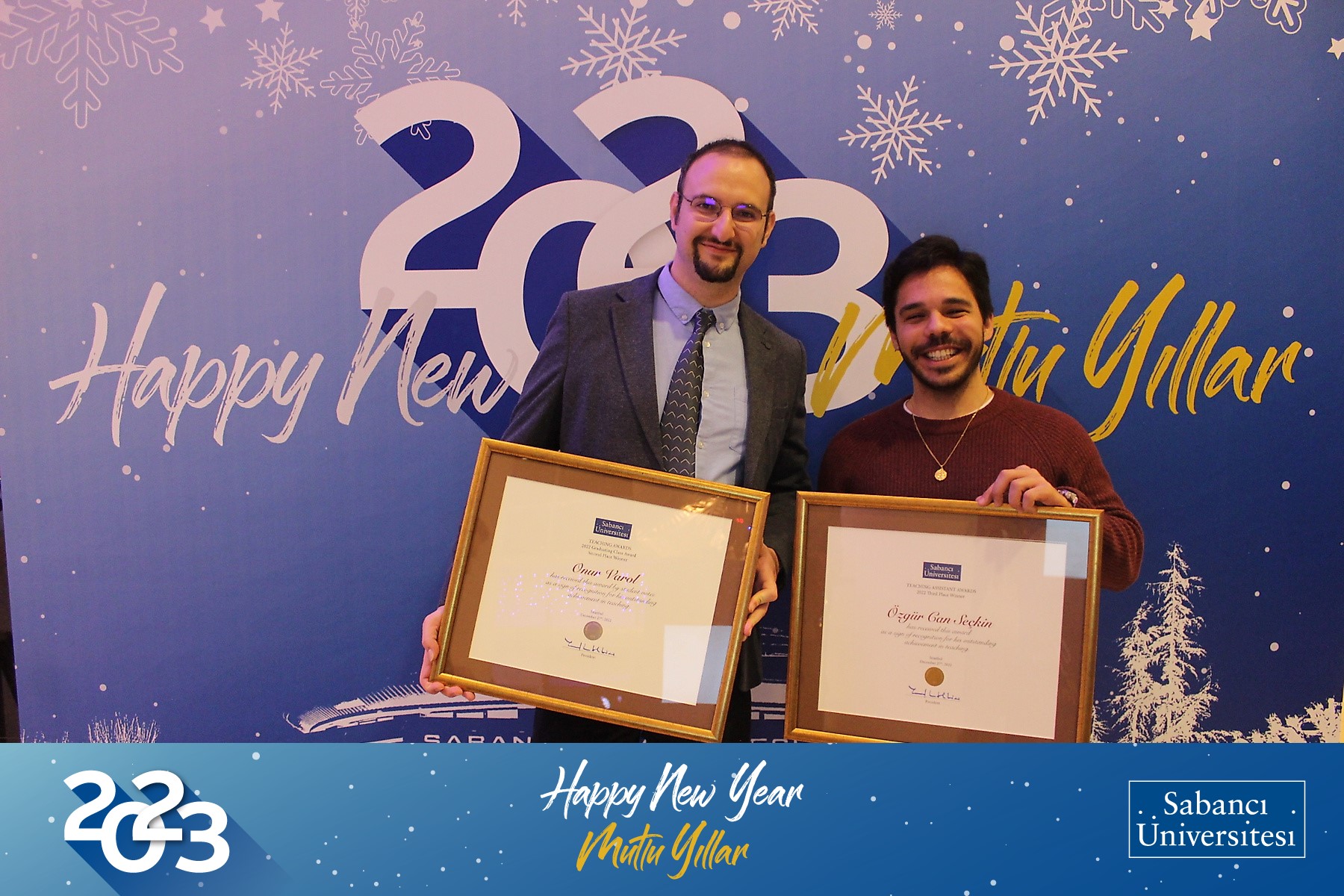
Spring semesters since 2021
Network science is a framework to analyze the complex systems of technological, biological, and cultural networks. This course will present the fundamentals of networks, mathematical toolsets to study and characterize networked data, and develop skills for network thinking. Special network topics such as network models, communities, and dynamics on networks will be presented.
Spring'23
Data science spans a large variety of disciplines and requires a collection of skills. This course is intended to tour the basic techniques of data science from manipulation and summarizing the important characteristics of a data set, basic statistical modeling, web programming and visualization.
Spring'22, Fall'23
This is an introductory machine learning course that will aim a solid understanding of the fundamental issues in machine learning (overfitting, bias/variance), together with several state-of-art approaches such as decision trees, linear regression, k-nearest neighbor, Bayesian classifiers, neural networks, logistic regression, and classifier combination. In addition to supervised approaches, unsupervised approaches will be covered, and model evaluations strategies will be introduced for different tasks.
July 2026
I was invited and became a part of the INSC Activity - I: Artificial Intelligence and Machine Learning (6th - 11th July, 2026). My lecture on focused on "Data Science for Social Good" theme. Abstract of the event can be seen below.
Abstract: In this lecture series, I will introduce the field of Computational Social Science (CSS) and demonstrate how it leverages diverse data modalities and machine learning frameworks to analyze complex social phenomena. Following an initial introduction to the foundations of CSS on the first day, we will conduct a deep dive into the specific methodologies used to study textual data (Day 2), image analysis (Day 3), and network models (Day 4). Each module will feature case studies from the CSS literature, highlighting creative applications of these tools to address critical societal problems. The final day is dedicated to presenting current research findings and practical applications from Dr. Varol's VIRAL Lab at Sabanci University.